

How Does Money Flow Through The Economy
3.3 The Circular Menses of Income
Learning Objectives
Subsequently you accept read this section, you should be able to answer the post-obit questions:
- What is the circular menstruation of income?
- What is the national income identity?
Looking at some basic measurements of the economic system has allowed you lot to exist more physical virtually the problems in Argentina. You written report back to the International monetary fund (Imf) team that production has been declining in recent years. You also report that there was a recent increase in the price level. As yet, though, you do not know anything about either the causes or the consequences of these events. Measurement of the economic system tells yous what has happened, but it tells you neither why information technology happened nor what it means. Measurement is not enough. We need frameworks to assistance us make sense of the information that we gather.
Economists use many different kinds of frameworks to make sense of an economic system. One of the most of import is called the circular flow of incomeThe money flows amongst the different sectors of an economy as individuals and firms buy and sell appurtenances and services. . To understand the circular menstruum, call up our working definition of economic activity: "goods and services produced for sale." And so far, nosotros have focused on production. Now we think about the "for sale" part.
Toolkit: Department 16.16 "The Round Flow of Income"
Equally individuals and firms buy and sell appurtenances and services, coin flows among the dissimilar sectors of the economy. The circular flow of income describes these flows of dollars. From a simple version of the circular menses, we larn that, as a matter of accounting,
gross domestic product (Gdp) = income = production = spending.
This relationship lies at the heart of macroeconomic analysis.
There are two sides to every transaction. When y'all purchase a piece of computer software, you lot give money to the seller, and the seller gives the software to y'all. (You might literally hand over dollar bills and receive a CD, or you might enter a credit card number into a website entitling you to a download. The idea is the same either style.) There is a flow of money from you to the seller and a menstruation of goods or services from the seller to you. This is true for all transactions: every bit individuals and firms purchase and sell goods and services, coin flows among the different sectors of the economy. Macroeconomists follow the money. By tracking these flows, we can understand the links betwixt different markets; by understanding these links, we gain insight into the operation of an economy.
One linkage is between income and spending. The spending by households on goods and services is funded by the income that households earn. But this income comes from firms, and they become their income from the spending of households. Thus in that location is a circular flow of income in an economic system as a whole.
Household income comes from 2 main sources: (1) Households contain workers who sell their time to firms and receive wages in return. (2) Households are the ultimate owners of the firms—shareholders live in houses besides—and thus any profits that firms make are returned to households. All firms in an economic system are owned by someone, and any profits they make do not vanish into thin air just must eventually show up every bit someone'south income.
Households take this income and do one of 2 things: they either spend information technology or save it. To start, let u.s.a. figure out what would happen if no household income is saved. Households spend all their income, and this money becomes the revenue of firms. Firms ship these revenues back to households, either as labor income or profits, and and so the circular flow continues.
The Simplest Version of the Circular Flow
We tin can make this idea more precise, using the pizza economy to illustrate. Imagine that our economy is composed of two sectors, which we phone call households and firms. Households supply labor to firms and are paid wages in return. Firms utilize that labor to produce pizzas and sell those pizzas to households. At that place is a flow of appurtenances (pizzas) from firms to households and a flow of labor services (worker hours) from households to firms. Because there are ii sides to every transaction, there is also a flow of dollars from households to firms, equally households purchase pizza, and a flow of dollars from firms to households, as firms pay workers.
For now, remember of firms equally very simple entities that pay out all the income they receive in the form of wages to workers. As a result, 300 billion pesos flow from the household sector to the firm sector (the purchase of pizzas) each year, while 300 billion pesos flow from the firm sector to the household sector (the payment of wages). These flows of pesos are illustrated in Effigy 3.11 "The Simplest Version of the Circular Flow". Think of this diagram equally representing the interaction of many households with many firms. A detail household works for 1 (or perhaps a few firms) simply purchases appurtenances and services from many firms. (If you like, imagine that different firms specialize in dissimilar kinds of pizza.) A feature of modernistic economies is that individuals specialize in production of goods and services but generalize in consumption by consuming many varieties of goods and services.
Effigy 3.11 The Simplest Version of the Circular Flow
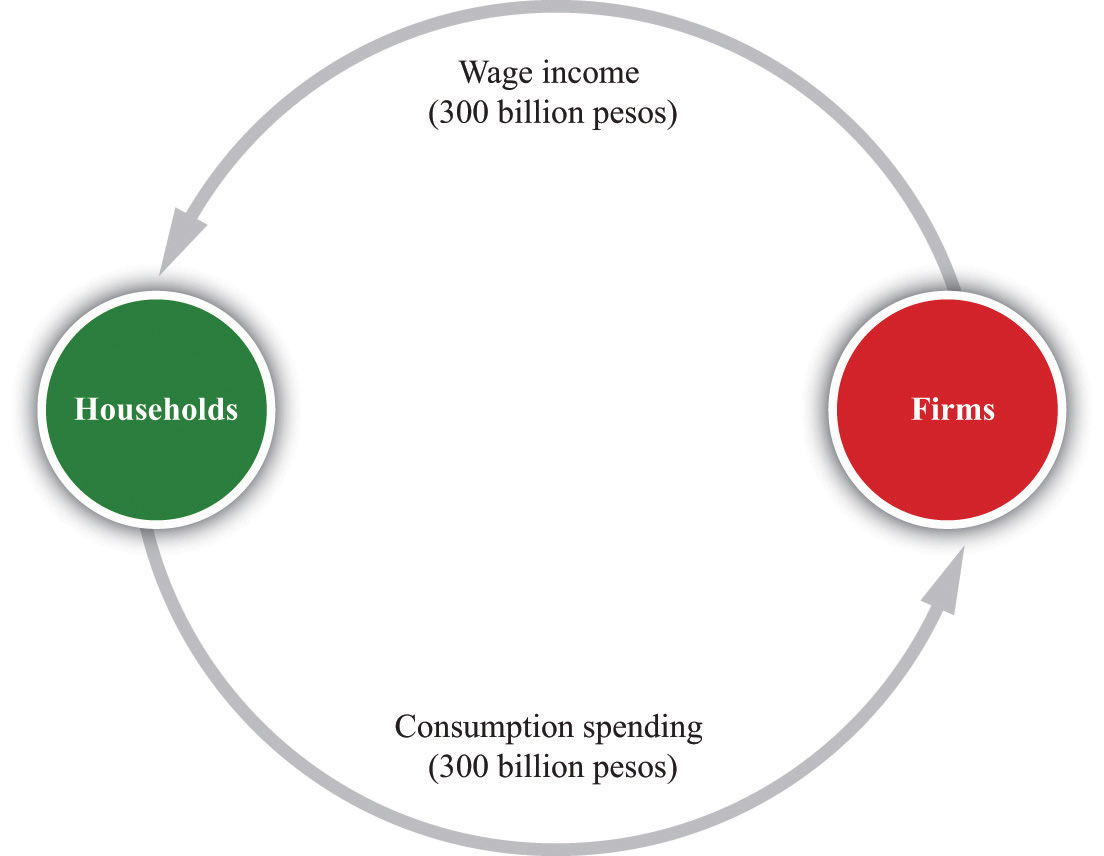
The circular flow of income follows the money in an economy. In the pizza economic system, firms produce pizzas and sell them to households, while households sell labor to firms and buy pizzas from them.
The circular flow reveals that in that location are several unlike ways to measure the level of economic activity. From the household perspective, we can look at either the amount of income earned by households or their level of spending. From the firm perspective, we tin look at either the level of revenues earned from sales or the amount of their payments to workers and shareholders. In all cases, the level of nominal economic activity would be measured at 300 billion pesos.
Respective to the flows of pesos shown in Figure three.11 "The Simplest Version of the Circular Flow", there are flows of goods and services between these sectors, as shown in Figure 3.12 "The Flows of Goods and Labor inside the Round Menses". The wage income received past consumers is payment for labor services that flow from households to firms. The consumption spending of households is payment for the goods that menses from firms to households.
Figure iii.12 The Flows of Appurtenances and Labor within the Round Period
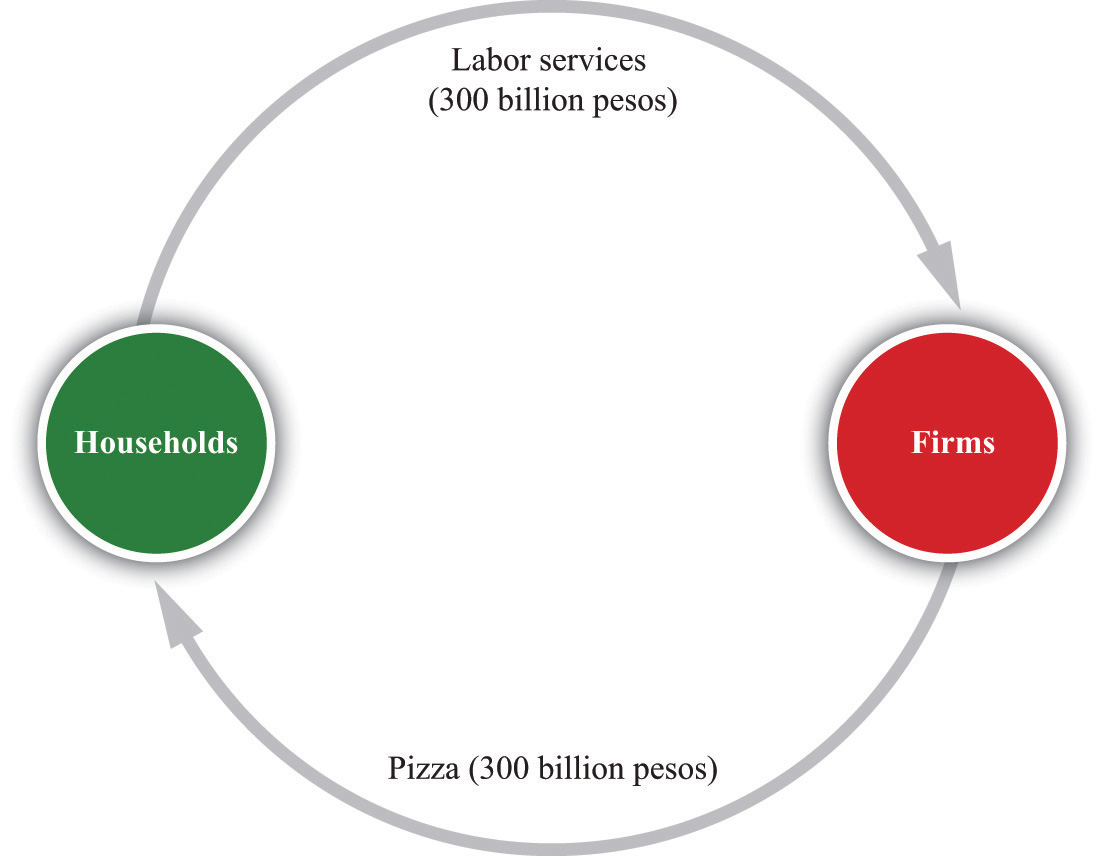
There are flows of appurtenances and labor services that correspond to the flows of pesos shown in Effigy 3.11 "The Simplest Version of the Circular Period". Three hundred billion pesos worth of pizza flows from firms to households, and 300 billion pesos worth of labor services menstruation from households to firms.
Of class, there are also flows of dollars within the household and firm sectors equally well as betwixt them. Importantly, firms purchase lots of goods and services from other firms. One of the beauties of the circular period construct is that it allows us to depict overall economical activeness without having to get into the detail of all the flows among firms.
Figure three.thirteen "Income, Spending, Payments to Inputs, and Revenues in the Unproblematic Circular Flow" shows us that the flows in and out of each sector must residuum. In the household sector, full spending past the household equals total income for the household. If spending equals income for each private household, then spending also equals income for the household sector as a whole. Similarly, each firm has a balance sheet. Accounting rules ensure that all of a firm'southward revenues must ultimately evidence upward on the other side of the balance sheet as payments for the inputs that the firm uses (in our uncomplicated instance, the business firm's only input is labor). Equally this is true for each individual firm, it is also true for the sector as a whole.
Figure 3.xiii Income, Spending, Payments to Inputs, and Revenues in the Simple Circular Flow
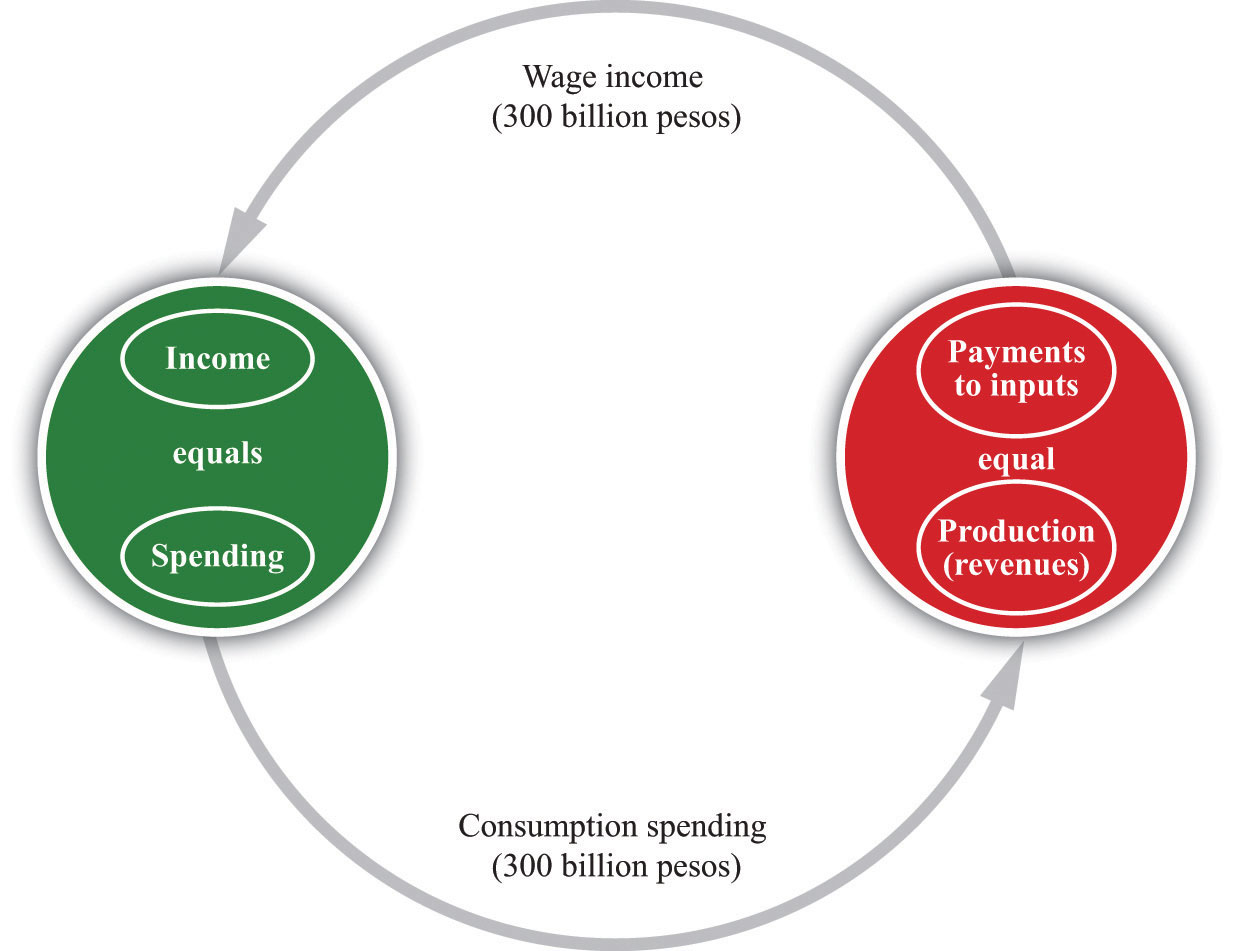
In each household, and thus in the household sector as a whole, income must equal spending. In each firm, and thus in the firm sector as a whole, revenues must equal payments to inputs. GDP measures the production of the economic system and total income in the economy. We can use the terms production, income, spending, and Gdp interchangeably.
Although this version of the circular menses is simple, information technology teaches us 4 key insights that remain true (albeit in slightly refined forms) in more sophisticated versions as well.
- Spending = production. The total value of all spending by households becomes an inflow into the firm sector and thus ends upwards on the revenue side of a house'southward balance canvas. The revenues received by firms provide u.s. with a mensurate of the total value of production in an economy.
- Production = payments to inputs. Flows in and out of the firm sector must balance. The revenues received past firms are ultimately paid out to households.
- Payments to inputs = income. Firms are legal entities, non people. We may talk in mutual spoken language of a business firm "making coin," but whatsoever income generated past a house must ultimately end up in the hands of real people—that is, in the household sector of an economic system. The full value of the goods produced by firms becomes an outflow of dollars from the firm sector. These dollars finish upward in the hands of households in the form of income. (This buying is achieved through many forms, ranging from firms that are endemic and operated by individuals to giant corporations whose buying is determined by stock holdings. Not all households own firms in this fashion, just in macroeconomics it is sufficient to think virtually the average household that does own stock in firms.)
- Income = spending. Nosotros complete the circumvolve past looking at the household sector. The dollars that flow into the household sector are the income of that sector. They must equal the dollars that flow out of the household sector—its spending.
The circular menses of income highlights a critical fact of national income accounting:
Gdp = income = spending = production.
Before, nosotros emphasized that Gdp measures the production of an economy. Now we see that GDP is equally a measure of the income of an economy. Again, this reflects the fact that there are two sides to each transaction. We can use the terms income, spending, product, and GDP completely interchangeably.
What does this mean for your cess of Argentine republic? For i thing, it tells you that the decline in real Gdp implies a corresponding pass up in income. Economists pay a swell bargain of attending to existent Gdp statistics for exactly this reason: such statistics provide information on the total corporeality of income earned in an economic system.
The Complete Circular Menses
Figure iii.14 "The Consummate Circular Flow" shows a more consummate version of the circular menstruation. It includes 5 sectors: the household and firm sectors that we accept seen already, a government sector, a financial sector, and a foreign sector. In every sector of the circular flow, accounting rules tell the states that the flow of money in must equal the period of coin out. When we wait at this sector by sector, nosotros discover v bookkeeping relationships, each playing an of import office in macroeconomics. For now, we take a very quick await at each one in turn.When nosotros revisit each sector in different chapters of this volume, we include more precise definitions and more than detailed discussion of the individual flows (such as consumption or government purchases).
Figure 3.14 The Complete Circular Menstruum
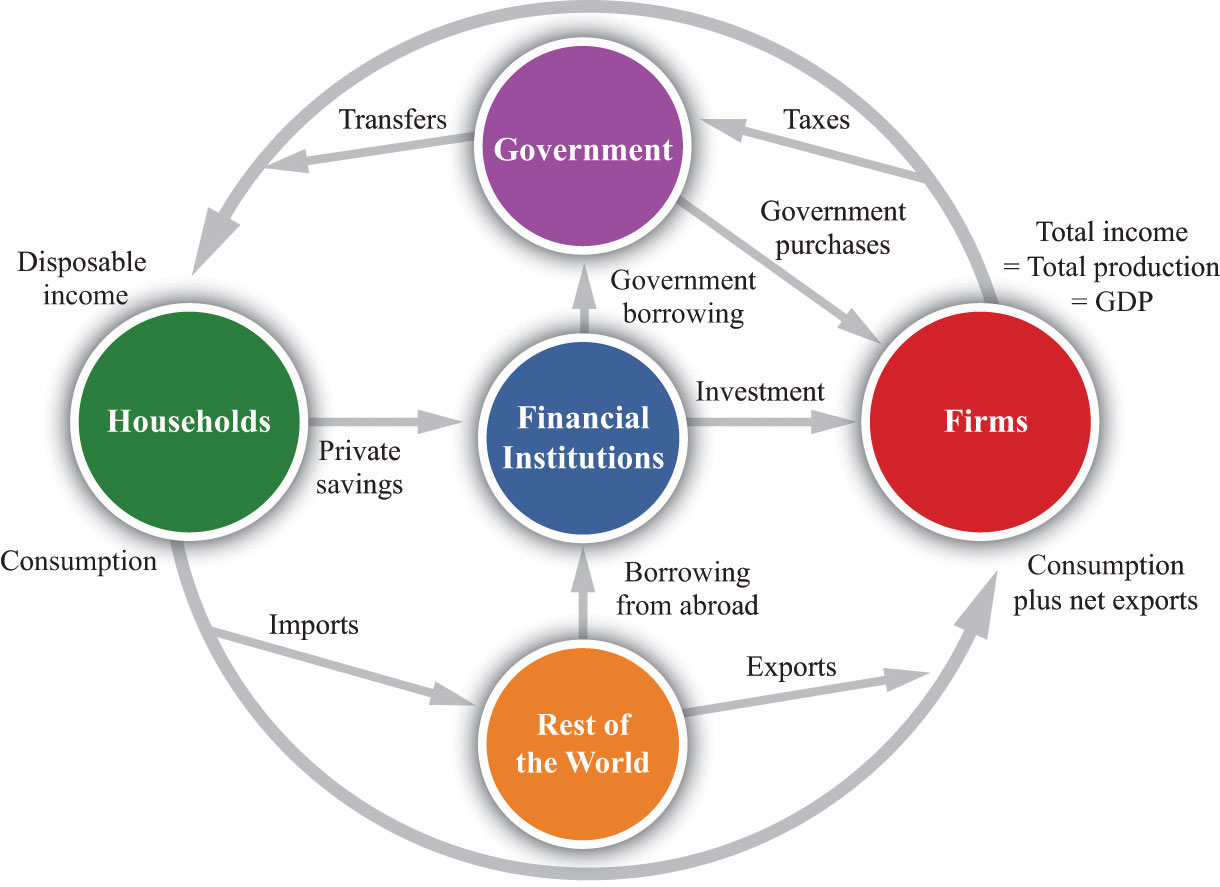
The round menstruation of income describes the flows of money amongst the dissimilar sectors of an economy. This representation includes the five main sectors: households, firms, government, the financial sector, and the rest of the world.
The Firm Sector
The flows in and out of the house sector of an economic system must balance. The total flow of dollars from the firm sector measures the full value of production in the economic system. The full flow of dollars into the firm sector equals total expenditures on GDP, which nosotros divide upwards into four categories.
Toolkit: Section 16.16 "The Circular Flow of Income"
The national income identityThe condition that product is the sum of consumption, investment, regime purchases, and net exports. is the condition that
product = consumption + investment + government purchases + cyberspace exports.
It is the almost fundamental relationship in the national accounts.
Consumption refers to total expenditures by households on final appurtenances and services. Investment refers to the purchase of goods and services that, in one way or another, aid to produce more output in the future. Government purchases are all the purchases of goods and services by the regime. Internet exports are the deviation between exports and imports: they measures the total expenditure flows associated with the rest of the world.These terms are explained in particular in Chapter 7 "The Nifty Depression".
The Household Sector
Households receive income from firms. They too receive money from the regime (transfers) and must pay money to the regime (taxes). Households spend some of their dispensable income and salve the rest. In other words,
income + transfers − taxes = consumption + individual savings.
In that location are many dissimilar means of saving, merely we do non focus on these differences. We simply imagine that households take their savings to financial markets to purchase interest-bearing assets. Some individual households are net borrowers, but, overall, the household sector saves. There is, on net, a flow of dollars from the household sector to the financial sector of an economy. These dollars are then available for firms to infringe to build new factories, install up-to-appointment equipment, and then on. That is, they are available for investment.The flows in and out of the household sector are discussed in Chapter 12 "Income Taxes".
The Regime Sector
From a macroeconomic perspective, the key functions of government are as follows:
- Information technology purchases appurtenances and services.
- It collects revenues through personal and corporate taxes and other fees.
- It gives transfers to households.
The amount that the government collects in taxes does not need to equal the amount that it pays out for government purchases and transfers. If the government spends more than than it gathers in taxes, and so information technology must borrow from the financial markets to brand up the shortfall.
Figure 3.14 "The Complete Circular Flow" shows two flows into the government sector and one flow out. Since the flows in and out of the government sector must balance, we know that
government purchases = revenue enhancement revenues − transfers + authorities borrowing.
Government borrowing is commonly referred to as the upkeep arrears. It is as well possible that the regime takes in more than than information technology spends, in which example the regime is saving rather than borrowing, so there is a budget surplus rather than a deficit.Regime finances are discussed in Chapter 14 "Balancing the Budget".
The Financial Sector
The financial sector of an economy is at the center of the round catamenia. It summarizes the beliefs of banks and other financial institutions. Most importantly, this sector of the round menstruum shows us that the savings of households provide the source of investment funds for firms. On the left-hand side, the figure shows a menstruation of dollars from the household sector into fiscal markets, representing the saving of households. (Though we have not included it in Figure 3.fourteen "The Complete Round Period", firms as well save, by means of profits that they retain to finance new investment rather than distribute to their shareholders. As far as the national accounts are concerned, it is as if firms sent these funds to the financial market and then borrowed them back once more.) When we infringe from other countries, at that place is a second flow of dollars into the financial markets. On the right-hand side, in that location is a period of money from the fiscal sector into the business firm sector, representing the funds that are available to firms for investment purposes. The linkage between the saving of households and the investment of firms is one of the near important ideas in macroeconomics.
The financial sector is as well linked to the authorities sector and the foreign sector. These flows can get in either management. As nosotros have already seen, if the authorities runs a arrears, information technology does so by borrowing from the financial markets. There is a flow from the financial sector to the regime sector. This is the case nosotros accept drawn in Effigy 3.14 "The Complete Round Menstruation". If the government were to run a surplus, the catamenia would go in the other direction: government would provide an additional source of saving. The foreign sector tin provide an additional source of funds for investment, if those in other countries decide they want to utilize some of their savings to buy assets in our economy. In this example, there is a flow from the strange sector into the financial sector. Again, this is the example we have drawn. If we lend to other countries, and then the flow goes in the other direction.
The flows in and out of the financial sector must remainder, so
investment + regime borrowing = private savings + borrowing from other countries.
The Foreign Sector
The foreign sector is possibly the hardest part of the circular flow to understand considering we have to know how international transactions are carried out.
Some of the appurtenances produced in an economy are not consumed by domestic households or firms in an economic system but are instead exported to other countries. Whenever one country sells something to another country, it acquires an asset from that country in exchange. For example, suppose a United states moving picture company sells DVDs to an Australian distributor. The simplest way to imagine this is to suppose that the distributor hands over Australian dollar bills to the movie company. The moving picture visitor—and, more generally, the The states economy—has now acquired a foreign asset—Australian dollars.
Because these Australian dollars can be used to purchase Australian goods and services at some time in the time to come, the Us economy has acquired a merits on Commonwealth of australia. In consequence, the Us has made a loan to Australia. It has sent appurtenances to Commonwealth of australia in exchange for the promise that it can claim Australian products at some time to come date.
Similarly, some of the goods consumed in our economy are non produced locally. For example, suppose that a US eating place chain purchases Argentine beef. These are imports. We could imagine that the eating house chain hands over US dollars to the Argentine farmers. In this instance, the United States has borrowed from Argentina. It has received goods from Argentina but has promised that information technology will requite some goods or services to Argentina in the time to come.
Of course, international transactions in practise are more complicated than these simple examples. Yet the insight we have just uncovered remains true no matter how intricate the underlying financial transactions are. Exports are equivalent to a loan to the rest of the globe. Imports are equivalent to borrowing from the rest of the world.
If we import more than nosotros export, then we are borrowing from the rest of the world. We tin can run into this by looking at the flows in and out of the foreign sector:
borrowing from abroad = imports − exports.
If we export more than nosotros import, then—on cyberspace—nosotros are lending to the rest of the world, and at that place is a flow of dollars from the financial markets to the rest of the world.
The Causes of a Decrease in Real GDP
Nosotros saw that, in Argentina, real GDP decreased betwixt 1998 and 2002. The circular period of income tells the states that when real Gross domestic product decreases, it must too be the case that real production decreases and real spending decreases. The Imf team in 2002 wanted to empathise why real GDP decreased. We are not going to answer that question in this chapter—afterwards all, we are notwithstanding at the very outset of your study of macroeconomics. Still, the circular menstruum still teaches us something very important. If real Gross domestic product decreased, and then there are really only two possibilities:
- For some reason, firms decided to produce less output. Every bit a consequence, households reduced their spending.
- For some reason, households decided to spend less money. As a consequence, firms reduced their product.
Of form, it could exist the case that both of these are true. This insight from the circular flow is a starting point for explaining what happened in Argentina and what happens in other countries when output decreases.
Key Takeaways
- The round flow of income illustrates the links betwixt income and spending in an economy. In its simplest course, acquirement earned past firms by selling their output ultimately flows to households, which spend this income on the output produced past firms.
- The national income identity says that total spending must equal total output and also must equal total income.
Checking Your Understanding
- What changes in Figure 3.14 "The Complete Circular Period" if the authorities takes in more revenue than information technology spends?
- Nosotros said that borrowing from away equals imports minus exports. Is there an analogous relationship that holds for an individual?
Source: https://saylordotorg.github.io/text_macroeconomics-theory-through-applications/s07-03-the-circular-flow-of-income.html
Posted by: brownbeffers1998.blogspot.com
0 Response to "How Does Money Flow Through The Economy"
Post a Comment